Vis and Analysis Tools

Images & Movies
Astrophysics
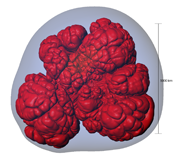 Type Ia Supernova: Turbulent Combustion at the Grandest Scale (video clip 2.5MB)** SciDAC 2010 VisNight Winner! ** |
Left: Deep inside a dying star in a galaxy far, far away, a carbon fusion flame ignites. Ignition may happen in the middle or displaced slightly to one side, but this simulation explores the consequences of central ignition. In a localized hot spot, represented here by a deformed sphere with an average radius of 100 km, carbon is assumed to have already fused to iron, producing hot ash (~10 billion K) with a density about 20% less than its surroundings. As the burning progresses, this hot buoyant ash rises up and interacts with cold fuel. Rayleigh-Taylor fingers give rise to shear and turbulence, which interacts with the flame, causing it to move faster. In about 2 seconds, the energy released blows the entire white dwarf star up, leaving nothing behind but a rapidly expanding cloud of radioactive nickel, iron, and other heavy elements. A Type Ia supernova is born. |
||
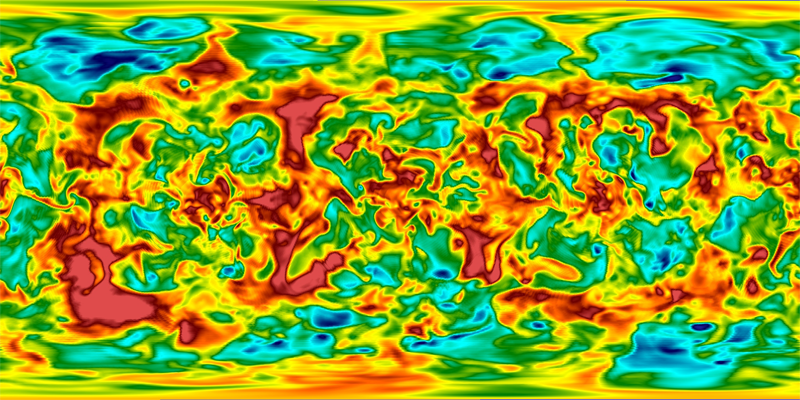
Image created by VACET for Adam Burrows (Princeton), who is part of the SciDAC Computational Astrophysics Consortium, as part of our ongoing user support mission. This image shows a radial slice of a CASTRO calculation shown on the "globe display" at the LBNL booth at SC09. |
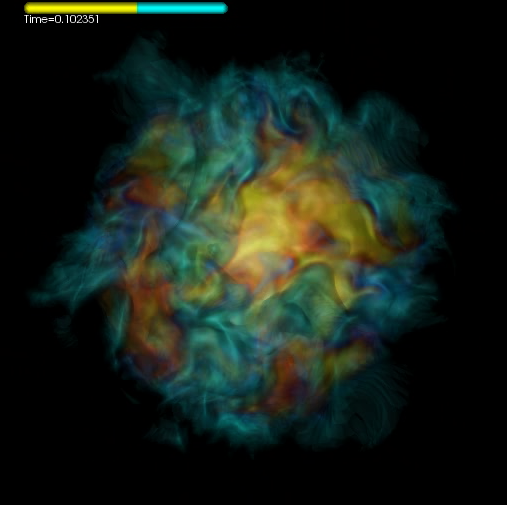
Image created by VACET for Adam Burrows (Princeton), who is part of the SciDAC Computational Astrophysics Consortium, as part of our ongoing user support mission. This image was is from a movie of CASTRO simulation output for Dr. Burrow's team showing the variable entropy. |
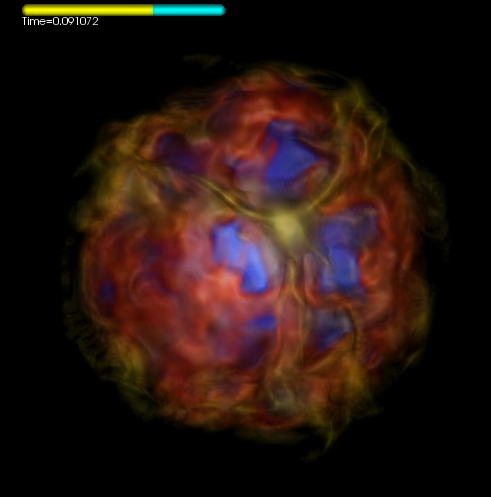
Image created by VACET for Adam Burrows (Princeton), who is part of the SciDAC Computational Astrophysics Consortium, as part of our ongoing user support mission. This image is from a movie of CASTRO simulation output for Dr. Burrow's team showing the variable Ye. |
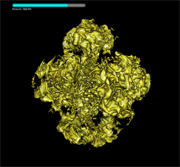
Image created by VACET for Adam Burrows (Princeton), who is part of the SciDAC Computational Astrophysics Consortium, as part of our ongoing user support mission. This image is from a movie of CASTRO simulation output for Dr. Burrow's team showing radial velocity. |
 Supernova Simulation Supernova Simulation
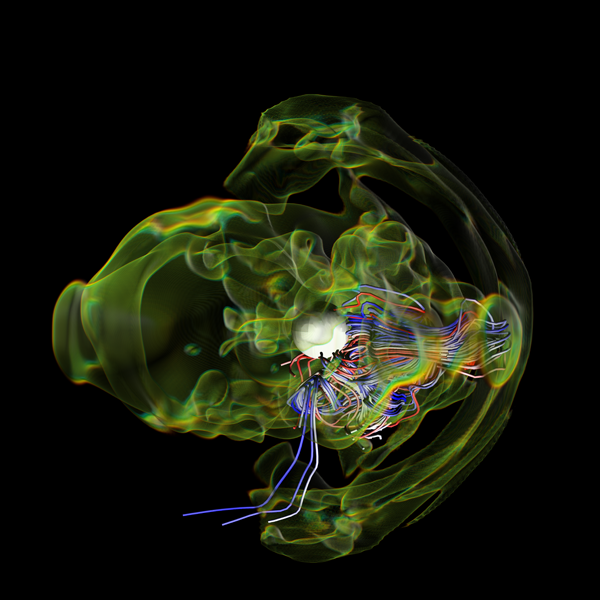
The collapse of massive star's core results in the formation of an outgoing spherical shock wave that eventually disrupts the entire star, giving rise to a supernova. Along the way the shock temporarily stalls and experiences the "stationary accretion shock instability" (SASI), which causes large deviations from spherical symmetry. This appears to be important to the supernova explosion mechanism, and may be responsible for spinning up the collapsed core---a nascent neutron star---into a pulsar. This image shows an exploratory view of a simulation run to ascertain the extent to which the SASI may generate magnetic fields: a volume rendering shows the fluid speed, and a sampling of fluid streamlines is colored by magnetic field strength. The simulation was run on Jaguar at NCCS with GenASiS, a multi-physics code under development for the simulation of astrophysical systems involving nuclear matter. |
|||
|
|||
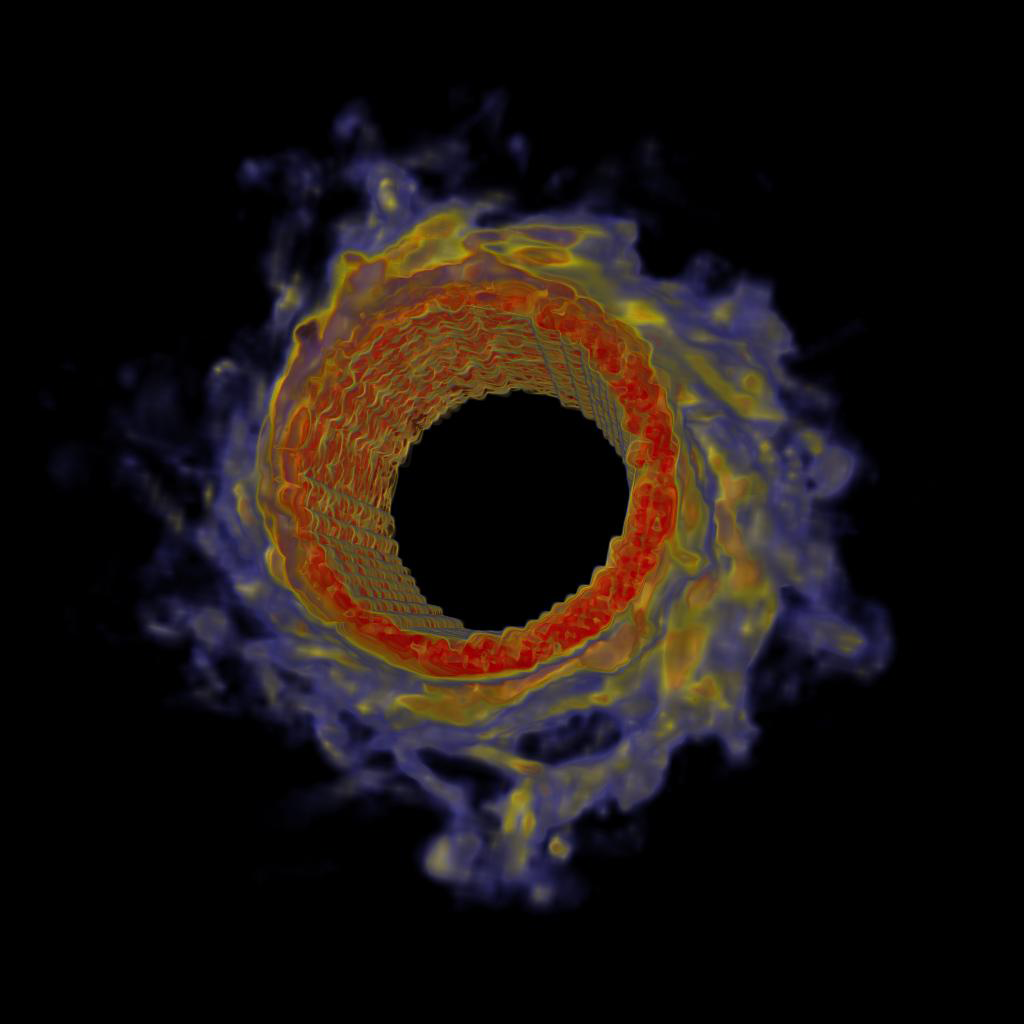
Visualization of Magneto-rotational instability and turbulent angular momentum transport. |
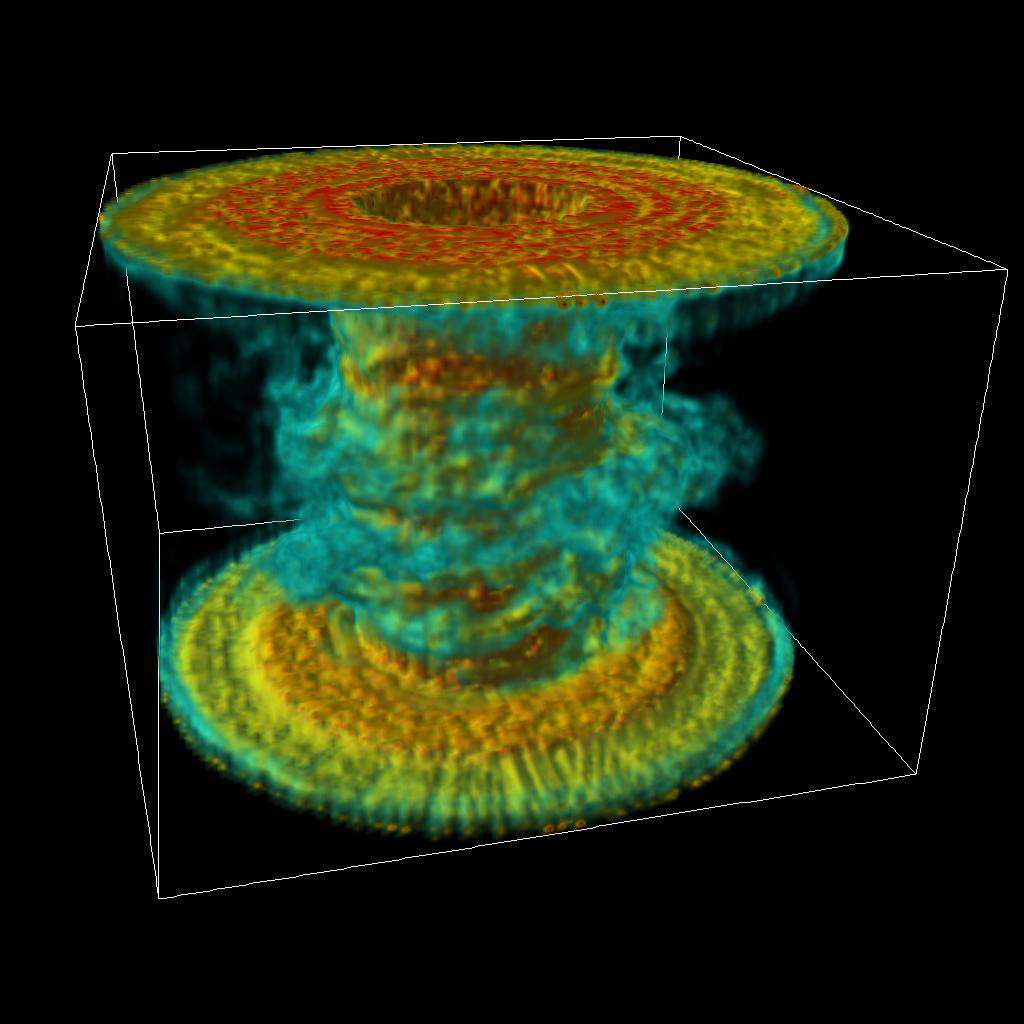
Visualization of Magneto-rotational instability and turbulent angular momentum transport. |
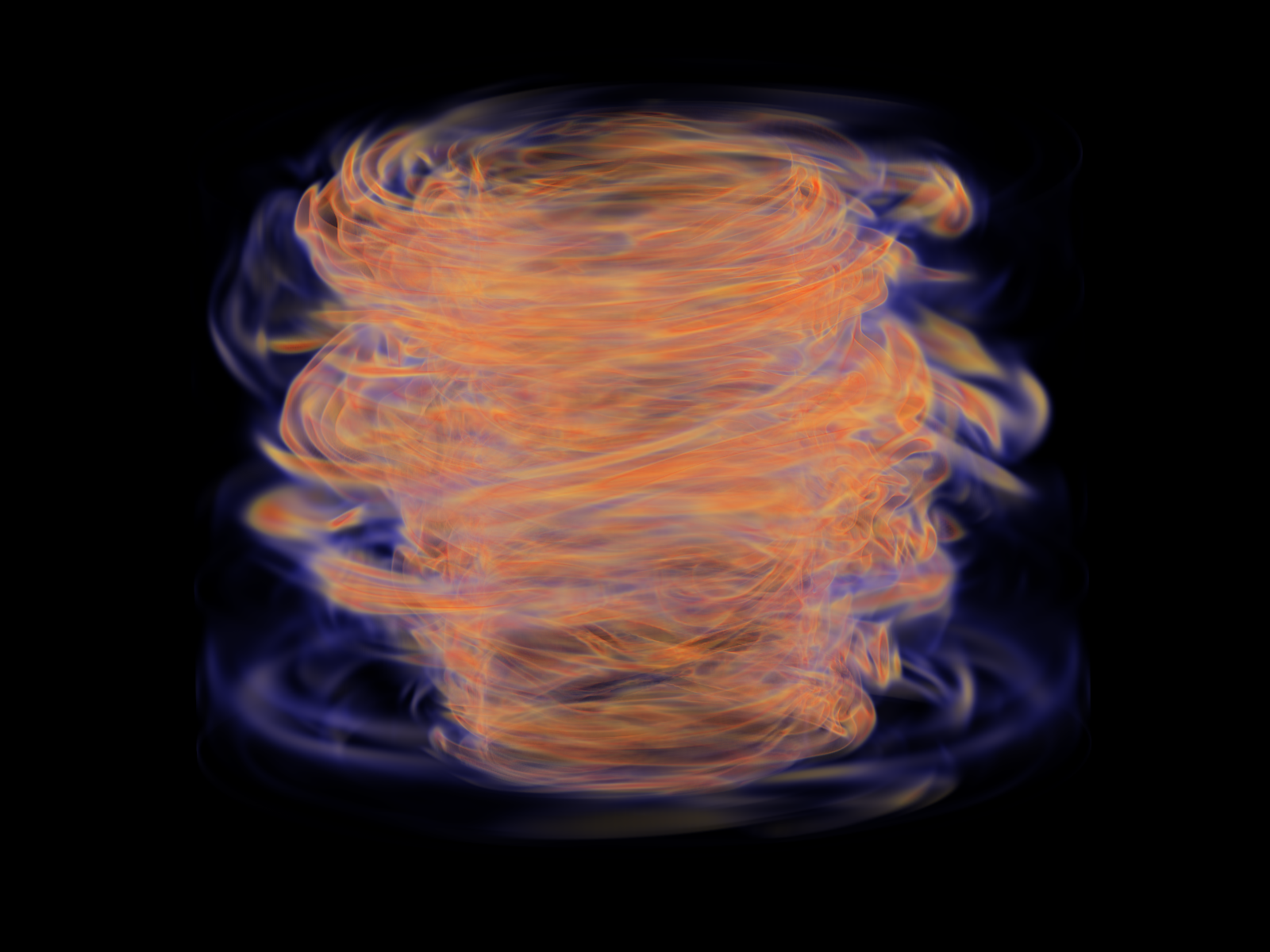
Visualization of Magneto-rotational instability and turbulent angular momentum transport. |
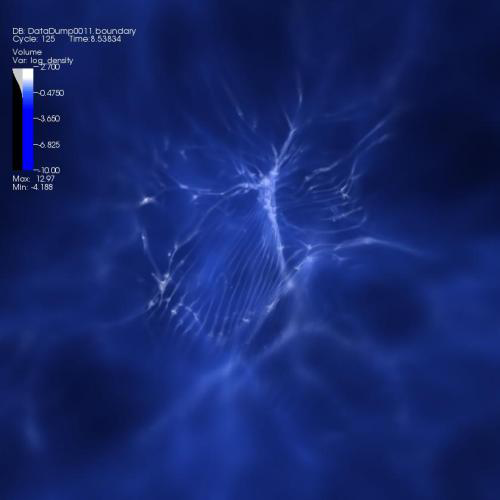
The featured plot is a Volume plot of the logarithm of gas/dust density in an Enzo star and galaxy simulation. Regions of high density are white while less dense regions are more blue and also more transparent. The data used to make this image were provided by Tom Abel Ph.D. and Matthew Turk of the Kavli Institute for Particle Astrophysics and Cosmology. |
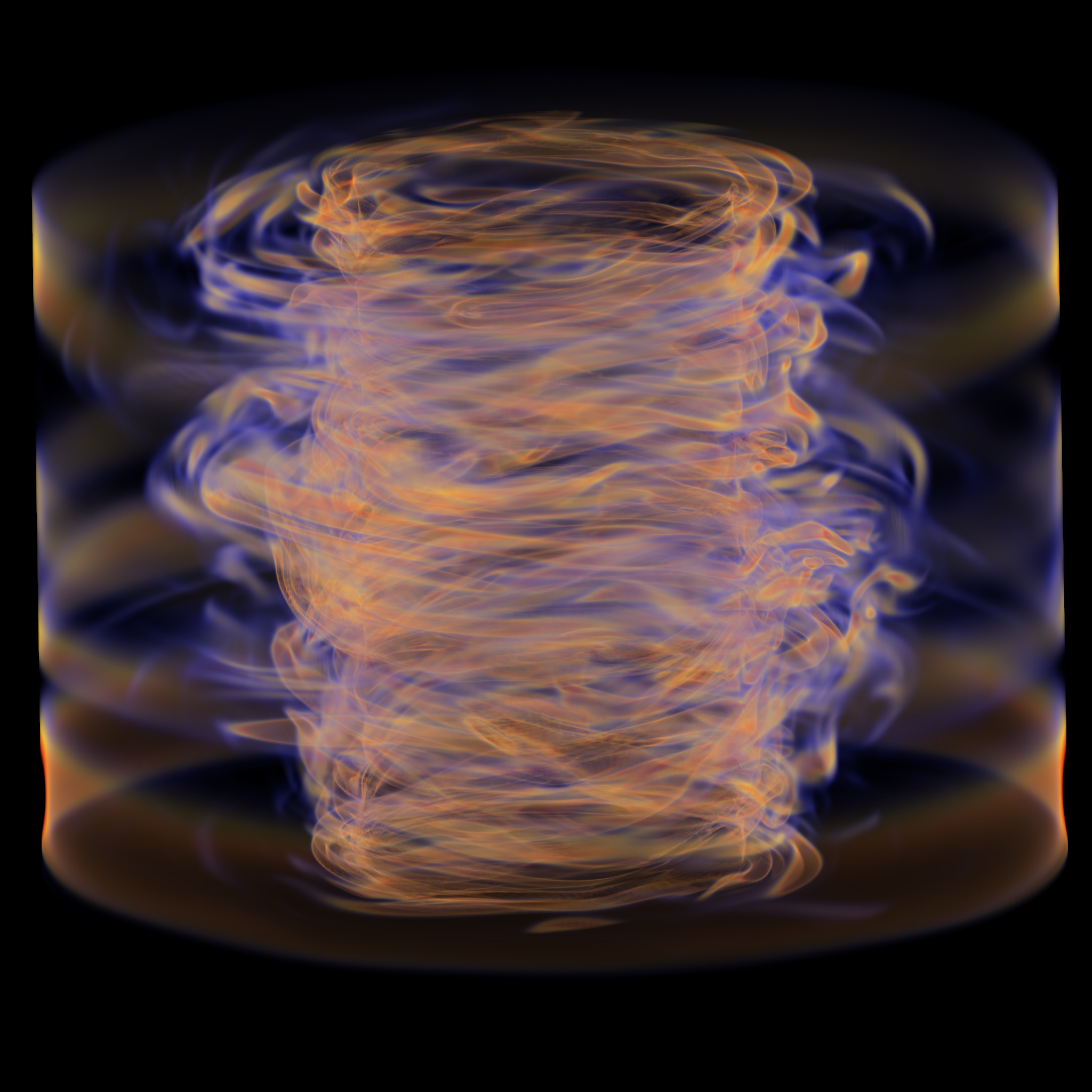
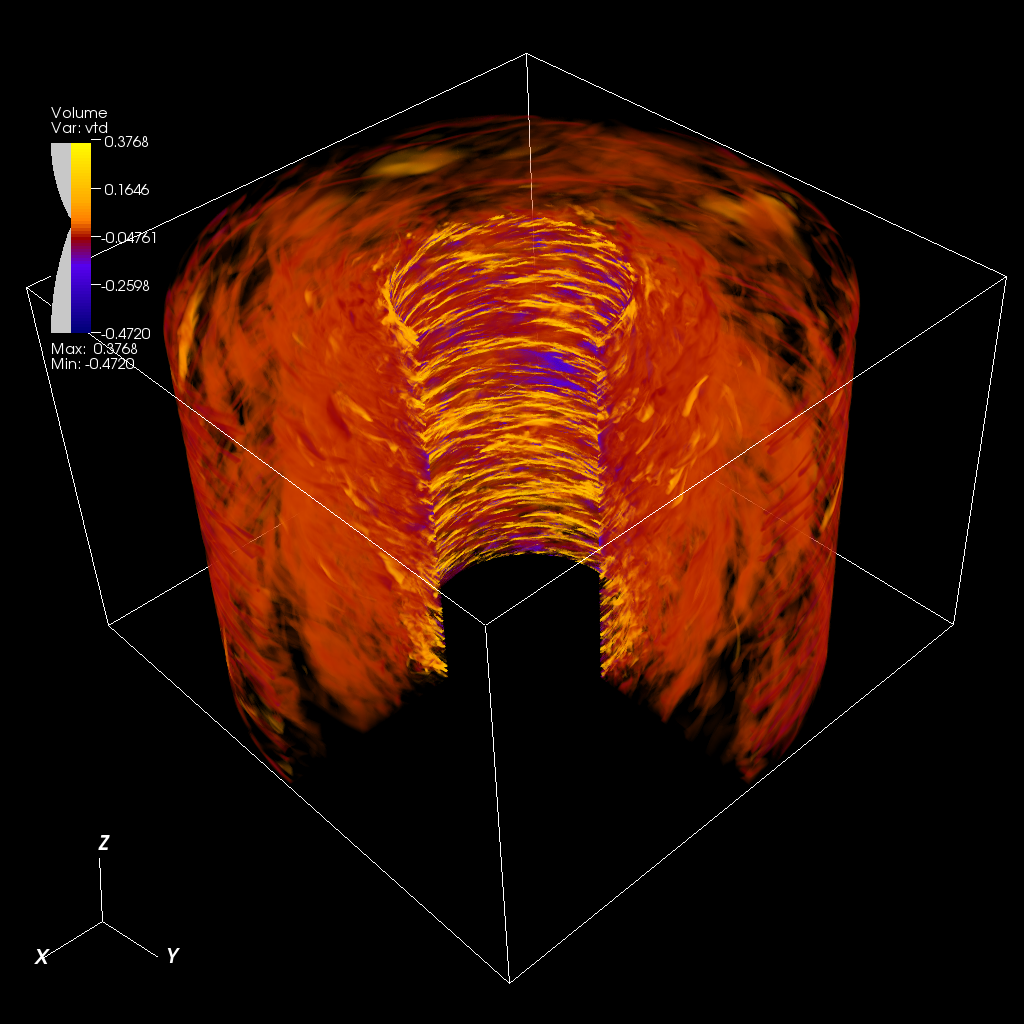
Visualizations of magnetically unstable cylindrical Couette
flow. This image shows the enstrophy and regions of high hydrodynamic
dissipation, and was created by Cristina Siegerist, LBNL, in a
collaborative effort between VACET, the NERSC Analytics program
(www.nersc.gov) |
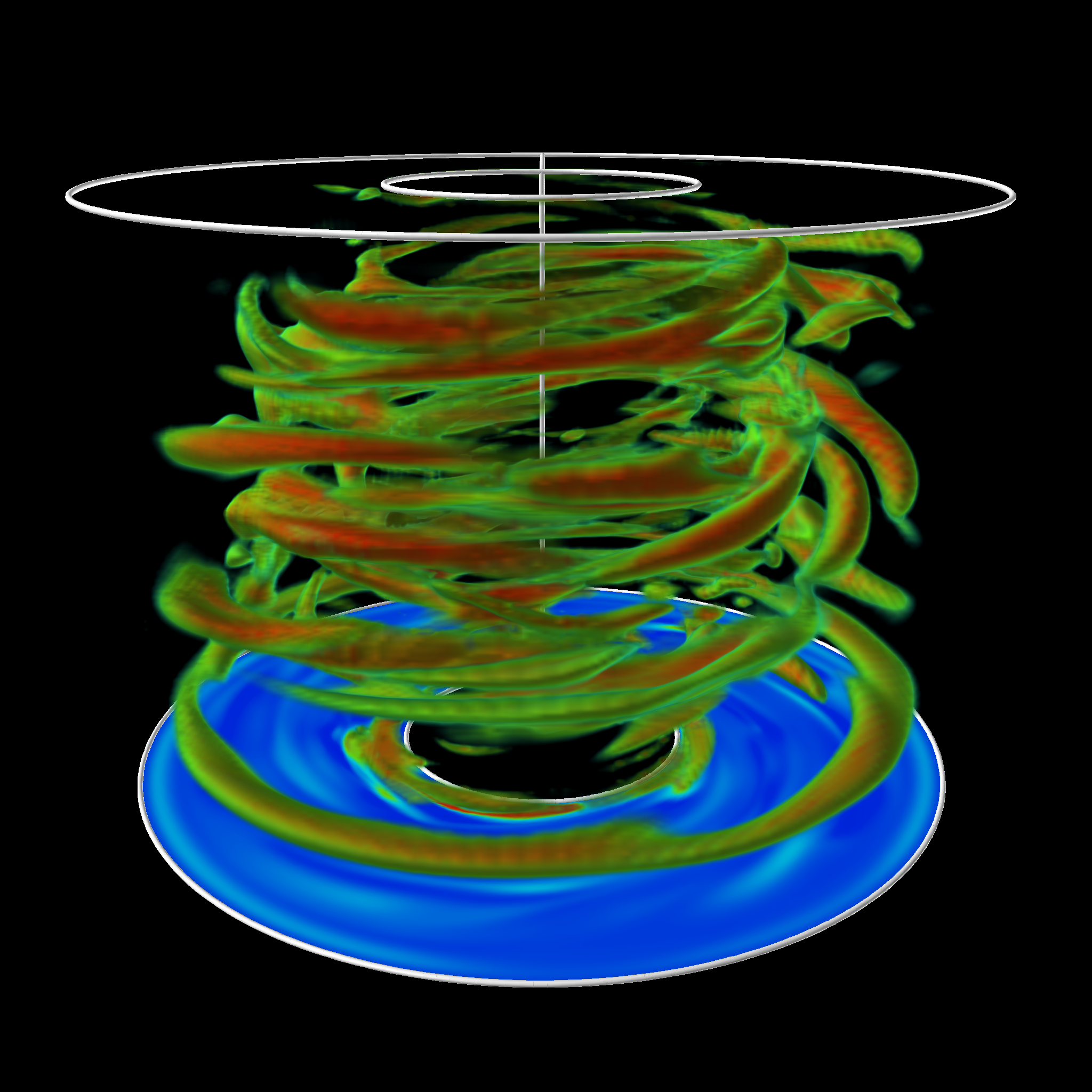
Visualizations of magnetically unstable cylindrical Couette
flow. This image shows the enstrophy and regions of high hydrodynamic
dissipation, and was created by Cristina Siegerist, LBNL, in a
collaborative effort between VACET, the NERSC Analytics program
(www.nersc.gov) |
||